Nothing is better than being able to hit the notes you want with ease and precision and have control over your breath. When your voice is in sync and nothing is holding you back from delivering a strong performance for your audience, it feels like freedom.
The key is in the approach, by being able to control certain vocal muscles to make room for those notes, as well as get control over the breath.
Here are 10 easy to apply techniques to try that can make the difference for you.
Everything I wanted—to be able to stand on the big stage and deliver a standing ovation performance— was because of vocal technique and applying these 10 secrets. I went from a girl with a breathy folky voice to a singer with the control and precision of my idols—it was a dream come true. And it can happen for you, if you follow the steps here and train with my Cole Vocal Method.
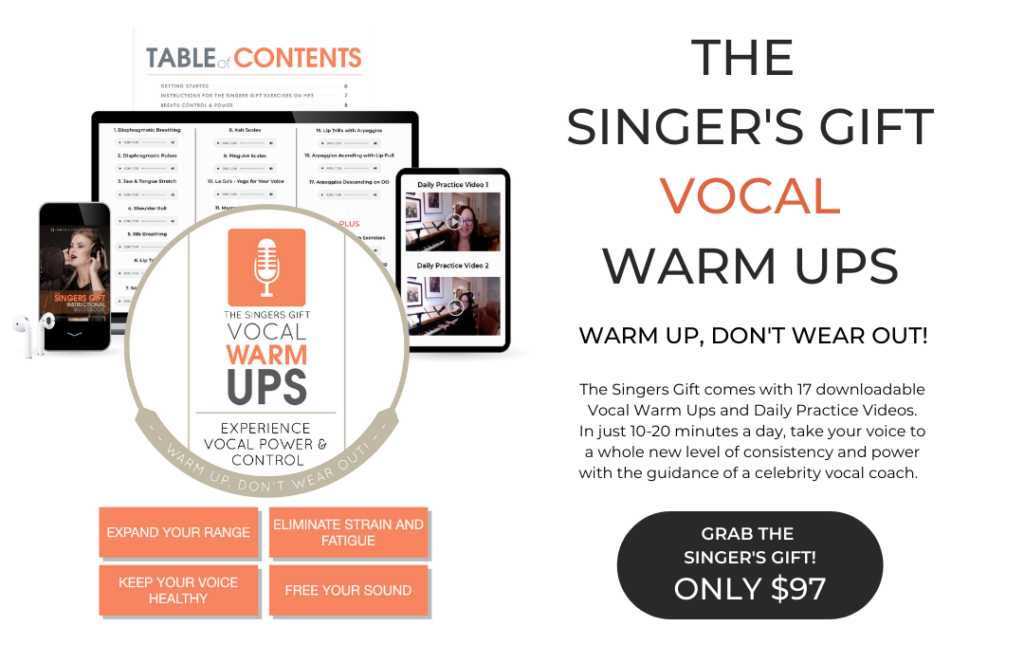
I hope they help you too. While these techniques listed here are valuable to try on your own, I highly recommend starting with my Cole Vocal Method by getting my Singers Gift Vocal Warmups where I guide you through the specific techniques to establish all 10 of these. You’ll also see demonstrations on video to help you do the correct positions.
1. Establish an open jaw
To get control over your voice and sound better right away you need to work on keeping a long oval position for your jaw on your vowels.
Exercise 1:
Slowly stretch your jaw with your hand with a gentle pulling motion. If you have TMJ be careful not to yank the jaw or exaggerate any clicking. You can avoid that by moving your jaw gently and slowly. Less tension in the jaw will help with belting safely as it tends to contract and cause more tension when singing more powerful notes.
Exercise 2:
- Grasp your jaw with your hand on your chin.
- Let your jaw fall open.
- Pull your jaw open another inch.
- Inhale and exhale from your mouth keeping this position.
- Say “Kah” without closing your jaw.
- Then say “Kah, kay, kee” without closing your jaw
- Then sing “Kah, kay, kee” on one pitch without closing your jaw.
- Try with all of the vowels “Kah, kay, kee, ki, koh, koo” without closing your jaw.
Ideally your tongue articulates the vowels while your jaw stays in a dropped position throughout singing. This is something that will instantly give more sound to your voice. It is something that is practiced over time in technique to execute naturally.
2. Stretch the tongue for more mobility and vocal control
To get control over your voice, we need to decrease tension in the tongue. Contraction in the tongue causes issues with articulation, nasality and tension in the singing voice.
The best approach is to start by stretching the tongue – gradually, slowly over a period of time to improve your vocal sound. Never yank or pull your tongue hard. It can seize up. Always be gentle but firm when stretching the tongue.
Exercise:
Start with the Lion stretch in Yoga. Stimulates Vocal Cords and Diaphragm. The Lion Pose in yoga engages your lungs, throat, and face, stimulating your diaphragm and vocal cords. It also helps to relieve tension in teh facial muscles and jaw. The yoga pose is ideal for anyone with speech impediments. Your voice-box or larynx has tissue folds known as vocal cords that protect the airway, regulate airflow into the lungs, and produce sound for speech. The movement of Lion Pose increased blood flow to the vocal cords and diaphragm, allowing for better voice amplification. This is benefited by the “Haaa” sound you make during the exhalation.
- Get into a kneeling position with hips resting on your feet.
- Place your hands on the knees and keep your arms straight.
- Extend your fingers and inhale some fresh air through your nose.
- Exhale slowly through your mouth by making a “Haaa” sound.
- Make sure you open your mouth wide while exhaling.
- Similarly, stick your tongue out toward your chin.
- Inhale and return to a neutral face. Repeat 5-8 times.
Practice my tongue stretches and singing exercises that stretch the tongue in my Singers Gift Vocal Warmup series here.
3. The “Tongue Drop ” Exercise
It’s important in vocal technique to practice movements controlling the front and back of your tongue to get control of your belt, open your throat, reduce nasality, build a belt voice and a strong bridge. The tongue plays an important role in a healthy and effective belt. In my Singers Gift Vocal Warmups I teach an exercise that helps you learn to control the back of your tongue.
Exercise 1:
- Bring an imaginary glass to your lips as if you were going to drink.
- Notice what happens in the back of your mouth. Did you feel the throat open?
- This is a movement you do throughout the day. A movement your body is used to that helps to open the throat and drop the back of the tongue. A great place to start is to get familiar with this motion and use it before any singing phrase or exercise. Keep in mind this is a subtle tension free movement. Don’t overdo it!
Exercise 2:
- Look in a mirror or camera.
- Hold your jaw open about 2″.
- Let the tip of your tongue rest on the inside of your bottom lip.
- Keep your tongue touching the inside of the bottom lip throughout the exercise. Don’t let it pull back in.
- Now – watch the back of your tongue.
- Say “Kah” (keeping the jaw open 2″ and the tip of your tongue touching the bottom lip as instructed above).
- Repeat.
- Now watch the movement of the back of the tongue as you say “Kah”.
- Did you see the back lift and then drop?
- Repeat 3-5x daily getting control over the back of your tongue.
Practice the tongue drop with the “Kah” singing exercise in my Singers Gift Vocal Warmup series here.
4. The Soft Palate Lift Exercise
Get Control of the Soft Palate: Getting control of the movement of the soft palate helps the belt. When the soft palate comes down too low it mutes the voice and causes problems with flat pitch or a thin belt. It’s also difficult to sing high notes without a lifted soft palate because you need the space inside the mouth to hold the fuller overtone series among other things. But like everything with the voice, these are subtle movements that need to be trained into the voice to create a natural reflex without overdoing it or over tensing!
Exercise 1:
- Trace the roof of your mouth with your tongue starting with the tip behind the back of the top teeth.
- Move your tongue along the roof of your mouth to the back.
- Notice where the hard palate turns soft?
- That soft area is called the soft palate.
- You want the soft palate to lift during singing – especially high notes.
Exercise 2:
- Do a gentle yawn.
- Do you notice any movement at the top of the mouth in the back?
- Repeat.
- Now – back to the imaginary glass at your lips as if to drink. Besides the tongue dropping and your throat opening, see if you can feel what’s happening at the top of your throat in the back?
Practice my “soft palate lift” exercise in my Singers Gift Vocal Warmup series here.
5. Developing laryngeal resistance (The Larynx Pull-down Exercise)
Building laryngeal depth: In vocal technique, we focus on building laryngeal depth. This helps us to control the belt, sing better high notes and overall to stablize the voice. When we belt or sing high notes we use more air pressure. Without training, this usually pushes the larynx into a high position, destablizing the voice. This can cause breaks or cracks in vocal production and cause problems with high notes or beltig. In my Singers Gift Vocal Warmups we practice vocal exercises holding the jaw down which lowers the laryngeal muscles while you sing.. This trains your voice to build laryngeal depth to improve overall vocal production and performance.
Exercise 1:
- Grasp your jaw with your hand.
- Place your finger horizontal at the top of your throat.
- Pull your jaw open 2″.
- Did you notice your finger and the larynx drop?
- This is the position that you want to practice vocal technique with to build natural laryngeal resistance.
Exercise 2:
- Put your fingers of one hand on either side of your throat at the top.
- Yawn.
- Slide your fingers down the sides of your throat as you yawn to gently pull the larynx down.
- This helps to decrease tension in teh voice, and stretch the throat muscles ot make it easier for them to slide down and have a more open throat during singing.
- This improves high notes and vocal control.
Practice my “larynx pull down” exercise in my Singers Gift Vocal Warmup series here.
6. Keeping the chest high to eliminate throat tension and get control of the breath
Chest height determines breath support. If the chest is drooped (most are) it prohibits the diaphragm from dropping and pulling air into the deeper recesses of the lungs. It also deflates any air in the lungs and makes you sing from your throat.
Try keeping the chest lifted during singing and breathing. The chest should stay lifted through inhale and exhale.
Exercise:
- Raise your chest up towards your chin. Keep your head level and the back of your neck lengthened..
- Inhale for 7 counts (seconds) sipping air through a small imaginary straw but silently.
- Hold for 4
- Slowly exhale for 7 counts out the mouth spreading out the breath evenly without dropping the chest.
- Repeat 3x times. Keep practiing this until you can inhale and exhale without dropping your chest on the exhale.
7. The head position determines breath support
Today as we all stare at our phones and computers, many struggle with a forward head position. When the head is forward, the neck muscles have to contract to hold the weight of the head which is 10-15 pounds over the body. This causes constriction of the neck muscles which in turn constrict the voice.
Ideally the head sits over the body or spine allowing the neck muscles to not have to contract as much creating less tension. This position also helps the singer to access breath support that is cut off with a forward head.
Muscles in their longest positions are the most released. Back of the neck tension causes problems with belting by overusing the neck muscles which only wear out the voice.
Exercise 1:
- Let your head fall forward in a slumped position.
- Take a deep breath and breathe into where it feels tight.
- Then on the exhale let your head slump more.
- Do this a few times to help the muscles stretch and release.
Exercise 2:
- Imagine a scarecrow figure. How the head sits on top of a stick that represents the spine.
- Imagine you are a scarecrow. Place your head up over your body lengthening the back of the neck and lifting the chest.
- For more help you can stand against a wall with your feet about 1 foot or 2 away from the way. Lean your hips into the wall.
- Then press the small of your back and your spine including your head against the wall.
- If you can’t keep the small of your back and your head against the wall you have a tight spinal alignment which is inhibiting your voice.
- This is a good stretch to do daily to stretch oout your spinal muscles to hold a more aligned and natural posture for singing.
8. Establishing a long neck supports your high notes and breath control
A forward head makes you sing on “muscle” vs. “air”. It often causes vocal problems and/or tension in the voice. When the head is forward
Exercise:
- Stand in front of a mirror.
- Turn slightly sideways. Look at your posture.
- Is your head in a forward position? Most likely.
- Now, raise your chest and stretch the back of your neck up toward the ceiling elongating your neck.
- This begins the process of stretching the back of your neck.
- With a forward head comes a contracted neck, and slumped shoulders which need to be stretched out. Yoga and massage or acupuncture help!
9. Keeping your head level and the chin dipped slightly down helps high notes and vocal control
To access better high notes, we practice tipping the chin slightly downward on high notes to help lift the palate and make room at the back of the neck. This makes high notes come out easier. When you are not trained, usually teh neck contracts and shortens pulling down the palate and causing trouble reaching high notes.
Exercise:
- Lift the chest and keep it lifted through the exercise
- Inhale and sing an ascending + descending scale on ah. C, D, E, F, G, F, E, D, C staring at middle C and moving upwards by a half step for 5 repetitions.
- Notice if you lift your chin up as the notes get higher?
- Keep it level and even tip it slightly downward as you get higher while maintaining a lifted chest.
- Did you notice it was easier to sing the higher note?
- To assist you more, you can press on your lifted chest – applying pressure to take the pressure off your throat and put it at the chest. This frees up the throat to produce high notes more easily!
10. Establishing Diaphragmatic Breathing by unlocking the ribs and stretching the intercostal muscles
The little known key to unlocking true diaphragmatic breathing is about breathing down into the ribcage and intercostal muscles. Abdominal breathing is usually what most coaches teach. That’s good too, but without unlocking the ribcage the diaphragm can stay elevated and not accessing the deeper recesses of the lungs and breath.
To develop breath control, breathe diaphragmatically and unlock the deeper recesses of your breath it starts with breathing down into the ribcage and then extending your exhale.
Exercise:
- Wrap your hands around your ribcage with the thumbs towards the back.
- Exhale and gently squeeze the ribs together.
- Keeping a little pressure on your ribs with your hands, inhale slowly into your ribs and hands.
- Do you feel the swing of your ribs as you inhale?
- Repeat. Breathing out and in slowly practicing feeling the ribs move.
- Now inhale for 10 counts (seconds) and exhale for 10.
- Start with 5 repetitions and build up to 10 repetitions.
- Once you get to 10 repetitions extend the exhale to 20 seconds.
The first goal is to move the ribs.
The second goals is to slow down the breath and get control of it.
The third goal is to extending the exhale twice as long as the inhale and get comfortable with it. This improves the depth of the breath and the relaxation and control of your breathing.
Practice my “diaphragmatic breathing” exercises in my Singers Gift Vocal Warmup series here.
Start here: The Singers Gift Vocal Warmups
Use the coupon code: SG25off at checkout to get $25.00 off your purchase