For every working singer, vocal health is paramount. It’s super simple. If you have no voice, there is no show. Most pop singers don’t fully realize that until they go on the road. And then the stark reality sets in. Singing is an athletic event, and voices are prone to burnout.
How do you keep your voice healthy?
It’s a science! As a celebrity vocal coach in New York City, I’ve spent my career helping singers keep their voice in peak condition and avoid losing their voices. In the article below I’ll be sharing tips from my step-by-step system that I’ve spent decades refining to keep singers performing, naturally.
I was happy to see singer Ariana Grande, who recently joined this season of The Voice, speaking up about vocal health. Kelly Clarkson and Ariana were ruminating about their methods for vocal health and how no one in the professional community has really spoken out about it until now.
I remember once working with Def Jam recording artist Chrisette Michele who commented to me in a voice lesson about the lack of support from labels regarding vocal health. How most labels don’t even put vocal health on the radar as important for their artists.
As an advocate and constant student of natural health alongside my profession as a voice coach led me to become an expert in vocal methods and remedies for keeping voices healthy. Within years of opening up my voice studio, I began getting referrals from New York ENT’s sending me their singers who were struggling with vocal health. I quickly realized that natural methods were far more effective than pharmaceuticals, primarily because they are better for solving issues versus masking symptoms. In addition, a common side effect of pharmaceutical medicine is dryness, which is brutal for the voice.
I am currently writing a holistic vocal health book. Join our list to follow along in the journey of vocal health and grab my Vocal Road Warrior 3 part audio series on How to Keep Your Voice Healthy On and Off Tour.
Take my Vocal Health Quiz to see where you land on the vocal health scale and what you can do to improve your vocal health and wellness.
Here are my top 10 Tips For How to Keep Your Singing Voice Healthy On the Road
1. Hydrate
I can’t say the word “hydrate” enough. Your voice needs water to perform well. Constant dehydration will lead to vocal problems such as hoarseness, loss of range, early fatigue, and will eventually lead to problems such as vocal loss or nodules among others.
Drink 6-8 glasses of water per day. No reason to over-hydrate though. And keep in mind that eating watery foods, smoothies, green juices contribute to your water intake (see Diet below for more information).
2. Steam
Increased vocal fold hydration is a popular target in the prevention and management of voice disorders. Current intervention strategies focus on enhancing both systemic (internal) and superficial (surface) hydration.
Internal hydration: Drinking water is a way to hydrate the body which hydrates the vocal folds. Steaming is a way to get hydration on the surface of the vocal folds (or cords).
Surface hydration: Breathing in steam is an excellent way to hydrate the surface of the vocal folds. Steam for 7-8 minutes a day, primarily before your vocal warmup exercises or an hour before your show. Regular steaming will improve vocal performance and longevity.
You can get a portable steamer for your voice that fits in your backpack. Super easy to use.
3. Massage + Self-Massage
Tension in the neck and shoulders, as well as in the muscles of your vocal instrument, contribute to vocal health issues. Sometimes tension is the sole cause of vocal problems.
Decades ago I started training in the highly specialized field of vocal massage. I trained with a woman Cathy Thompson (who has since passed away), who was trained by Ida Rolf, the founder of Rolfing herself.
At the time Cathy was working with singers such as Sting, Bruce Springsteen and others keeping their voices in healthy working condition. As I applied the techniques with my own clients, I was astonished at the results. In some cases, an hour of deep vocal massage could restore a voice.
I recommend finding a Structural Alignment practitioner in your area (this technique developed from the Rolfing method). Or someone who does deep tissue massage.
I’ve also developed a method for self-massage that I use with my clients. You can find out more about that in the Vocal Resource Library ebook I created.
4. Throat Balm
Throat balm is so helpful to reduce tension in the muscles surrounding your vocal instrument. I use a product made by Sunrider International called “Sunbreeze balm”. Similar to the better-known Tiger balm sold at health food stores, Sunbreeze balm is applied to the throat, neck and shoulder area to reduce tension and provide immediate relief.
Every singer I have turned on to this balm falls in love. It has camphor in it, so it has an instant de-stressing effect. It also opens up your breathing, a stuffy nose, and reduces headaches. For singers, decreasing tension in the neck helps to improve range and reduce hoarseness and fatigue.
Slap some balm on your neck and throat area pre-rehearsal and show to stay tension-free and feeling more open vocally.
5. Larynx Pull Down
The Larynx Pull is a technique I developed as a part of my vocal massage training that immediately reduces throat tension and helps to recover the voice from over-singing. Touring singers are always battling tension and in addition, the larynx can get pushed up into too high of a position as well, causing tension and issues with fatigue and the break.
Using the Larynx Pull Down technique that I teach in my Singers Gift Warmups will help to instantly reduce tension from over-singing. Great to do pre-show or after a long night of singing.
Additional tip: Apply the Sunbreeze balm on your throat right before you do the Larynx Pull Down for even better results.
6. Stretching + Yoga
To keep your voice performing night after night on tour is going to require that you do some form of stretching or yoga even if it is just 15 min.
Stretching reduces tension in your muscles and keeps your voice limber and performing well.
Grab a 15-minute yoga class on YouTube or do some whole-body stretches in your hotel room in preparation for your performance.
7. The Singer’s Diet
On tour, it’s important to stay away from fried, carbonated, heavy, acidic foods if you want your voice to last and not burn out.
One of my students who trained with me for many years reached out after being on the road for a bit. She had started losing her voice at the end of every tour out of the blue. After I ran through my exhaustive list of questions I was able to narrow it down to her diet. Following pretty much every performance she would treat herself with a beer and an order of french fries. But the problem was, that beer as a carbonated beverage will back up stomach acid in the esophagus and french fries which are highly acidic, will cause laryngeal reflux. Following my suggestion to find another treat that didn’t cause these issues, she reported that lo and behold she sailed through her next tour and the problem was solved. Of course, this is just one example of how diet can cause vocal loss. However, there are many potential causes for losing your voice on tour, primarily vocal weakness and lack of a good vocal technique.
Here are a few recommendations for a healthy diet to maintain on the road. Given that greens are not always readily available, I have made some alternative suggestions to help.
Hydrating foods and beverages (all organic whenever possible):
- Spring or filtered water
- Smoothies
- Melon: watermelon, cantaloupe, honeydew (throw some chunks in your water for extra moisture)
- Green juice
- Fresh salad w/lemon and olive oil
- Veggies: all kinds!
- Brothy soups
- Protein:
- Vegan: beans, tofu, hemp seeds and hemp seed powder
- Vegetarian: eggs, soft cheeses (goat, feta) and above
- Pescatarian: fish and above
- Omnivore: meat, chicken, etc. and above
- Stay away from milk (mucus forming) and processed foods: cereals, pasta, breads, gluten, etc.
- Keep in mind that eating watery foods, smoothies, green juices contribute to your hydration intake and improve performance.
8. Warming Up
Warming Up is not an option if you want to have good vocal health on tour, but knowing which warmup to use is the trick. My warmups are designed to open and free your voice for performance and have massage elements woven into the exercises to reduce tension pre-performance.
Also, a quick tip about warming up your voice. Keep your volume in check. Sometimes singers, in an effort to feel confident about their voices pre show will belt at the top of the lungs, just to check that it’s still there :). However, this only causes strain on your voice. Save your belting for performance and warm up at a moderate volume for the best performance results.
You can find out more about them here.

9. Cool Downs
Cooling down your voice post show is the quickest way to maintain your vocal health on tour. During a show, your vocal cords can swell up a little to a lot – depending on how vocally healthy you are or how good your technique is. Even for well trained singers there is still a little inflammation that occurs, particularly in a longer show.
I was lucky enough to learn these magical techniques for reducing inflammation early on in my vocal training and I include them in all of my exercises.
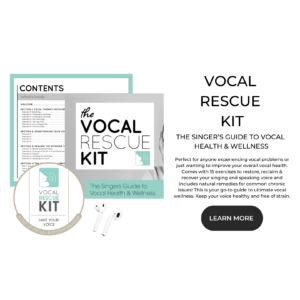
My vocal exercise products, the Singers Gift Vocal Warmups and the Vocal Rescue Kit (vocal therapy exercises) both have specifically formulated exercises in them that reduce inflammation on the vocal cords themselves. These cool down exercises were created by my mentor’s mentor and then handed down to me. They are the very best cool downs on the market and really help to maintain good vocal health.
10. Don’t Talk Too Much if You Don’t Have to
Oftentimes singers have to do a lot of talking on tour on top of their concerts (radio shows, interviews, talking to people over loud music in clubs). I find that the speaking voice can sometimes be the cause of vocal problems on the road. It’s important to pace yourself, don’t load up on too many things (just pick the best ones), and limit talking when you don’t have to. Celine Dion during her several-year engagement at Caesar’s Palace in Vegas used to tap Morse code to her husband to save her voice for her performances.
Take my Vocal Health Quiz to determine the quality of your vocal health here.