Many famous singers started out their careers becoming background vocalists. It’s a great way to build your career, bring home some cash, and build your network of industry connections.
I had my own stint as a background vocalist and session singer earlier on in my career as a singer and musician. At the time singing commercials (“jingles”) was all the rage. I worked with someone who was already a session singer who brought me in on sessions. To qualify I had already been to music school, could read music, was trained in sight-singing, and was an accomplished vocalist with 5 years of solid vocal training behind me. I also had 5 years of performing live and recording under my belt.
It’s a super cool way to grow your confidence as a singer, grow your industry contacts and support your music career. Many famous singers came up in the ranks singing backgrounds! Background vocals are the bomb!
An impressive list of famous singers who were background singers for well-known artists are:
- Sheryl Crow sang backup for Michael Jackson and Stevie Wonder
- Gwen Stefani was originally hired to sing back up for No Doubt and went on to become the lead singer
- Dave Grohl sang for Nirvana before forming Foo Fighters
- Whitney Houston sang backup for Chaka Khan
- John Legend sang backup for Alicia Keys and Kanye West
- Cher recorded background vocals on The Ronettes Be My Baby and You’ve Lost That Lovin’ Feelin’ by The Righteous Brothers.
Backup singers must be highly skilled in vocal harmonies and have a good musical ear. They are among the most versatile and skilled vocalists out there. They are hired for their ability to walk into a session, look over a piece of sheet music, or hear a track once and nail the part on the first take with little or no rehearsal.
They are able to sing in multiple genres, shifting their vocal style as needed. In a week a background vocalist might sing harmonies on a pop hit, sing on a jazz record, or on a hip-hop track.
What kinds of work can you expect?
- Supporting an artist on tour, concerts, festivals, one-off performances
- Providing vocals for an advertisement
- Video game soundtrack
- Television broadcast supporting an artist
- Film score
- Live-performing backup singers assist artists on tour, at special concerts and festivals, and during television broadcasts, bringing layered studio harmonies to life.
- If they’re working with a pop star, live backup singers may learn and perform choreography as part of the job.
In each setting, backup singers are required to perfectly complement but never overshadow the lead singer. You have to learn how to blend with the lead voice precisely matching the singer’s tone, personality, rhythm, phrasing, and accent as well as providing contrasting textures when needed.
Backup singers are vocal chameleons. Having a top-notch quality professional voice and prior studio experience is necessary.
What you need to get started:
- An A-game professional vocal technique and system under your belt. (*see “How We Can Help” below)
- Prior studio experience is necessary. You can get this by volunteering to do favors for friends who have studio projects.
- Experience working with professionals, starting with a vocal arranger (*see “How We Can Help” below)
- A Vocal Reel: A strong vocal reel that shows versatility and strengths (*see “How We Can Help” below)
- Your reel should first show your range of versatility
- However, don’t try to sing stuff that is not your strength. You also need to feature your strengths.
- Network. This takes time and persistence, and people skills are necessary. Go to writers’ nights and to concerts; hang out with songwriters, producers, and people in the business.
How We Can Help:
- Our Vocal Team are already accomplished, background vocalists. We can review your vocals and get you industry-ready and we can also work with you on developing your vocal reel. Work with us here.
- We have one of the best vocal technique methods on the market to build a professional voice. Get started with our technique here. Or reach out to our team to learn more about our method at info@caricole.com.
- Our Vocal Team are also vocal arrangers. See how it’s done, work with one here.
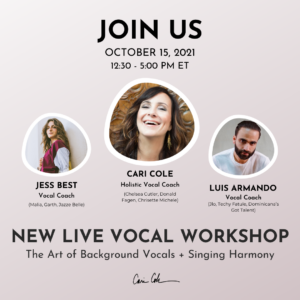
- Throughout the year we give several vocal workshops that teach you the industry and bolster your craft. Each time our topic is brand new. This month we have a workshop called “The Art of Background Vocals + Singing Harmony” – join us here.
Where do you find work?
Most are freelancers hired by an artist, producer, recording engineer, or music director, and may choose to take on both studio and live work or focus their career on one area.
Where can you post your reel?
There are some amazing places online to post your reel. Online platforms like SoundBetter.com.
What can you expect to earn?
Per session: $40.00-$250.00+
Per year: Backup singers can earn average salary of nearly $40,000+ per year.
Royalties: Under a partnership agreement between AFTRA and AFM, backup singers, or non-featured singers, are paid royalties and a session fee.
Joining AFTRA (Union): Because many record labels have agreements with the American Federation of Television and Radio Artists (AFTRA) and the American Federation of Musicians (AFM), singers must join the union to begin recording. This includes backup singers. Under a partnership agreement between AFTRA and AFM, backup singers, or non-featured singers, are paid royalties and a session fee. Soloist and duo rates for a three-hour recording session for a CD is $203.75 as of 2008. Singers working late night, weekend or holiday sessions may receive an additional 50 to 100 percent surcharge added to their wages. Making a CD may require more than 50 hours for vocals recordings and the average backup singer may work on a few albums per year.