

The Ultimate Singer: 6 Tips to Stunning Vocal Performances

This post helps you get started, but that’s only the beginning. What would it feel like to sing your heart out with a transformed voice performing to thousands of people by the end of the year? Come join the tens of thousands of singers who have already transformed their voices with my Singers Gift Warmups. Set your voice free in just 20 minutes a day with these revolutionary techniques found only here! Click here to find out how.

Live vocal performance and recording is where you want to perform at your very best to deliver the height of emotion and expression to impress and inspire your audience. Whether you are preparing for a livestream, recording, or performance, it’s important to workshop your songs technically aa well as connect with your songs on a deeper emotional level. Both are avenues to improve your overall vocal performance delivery when you need it the most.
Here are my top 5 tips for how to step into your best performances ever!
1. Mastering a Song
Mastering a song involved everything from vocal technique to lyric interpretation, to developing your own phrasing, styling and a solid vocal arrangement. Here’s a peek:
- Memorize your song (no peeking at lyric sheets). Memorize your melody and lyric first. Type or write out a master lyric sheet to keep notes on for rehearsal (like where breath marks are) – but once you are in rehearsal with the band toss the notes.
- The right key: If you aren’t singing in the right key of your voice, no amount of rehearsal is going to do it for you. How can you be sure? If it feels good and shows off the height of your voice it’s probably right. One half step in either direction can make the difference in how your voice sounds. Sometimes I write a song in one key and end up recording it in a higher or lower key depending on where the melody sits. I like the key to suit where I sound best. The best way to determine this is to try several keys close to the original key and get some feedback as to which key sounds best on you!
- Learn the melody. Each song has a completely different melody making each song a completely different challenge for your voice. See #2 below for detailed instructions.
- Making it yours. One of the keys to making a song yours is to let your own voice be the guide and being willing to improvise. Start noticing what your voice wants to do. When your voice want to take a breath, take a breath. When you want to hold a note out, try it. Copying another’s phrasing can only limit your own sound and ability. Push past your fear of unknown notes and be willing to experiment. Record your meanderings and listen back. Try embellishing on the melody line where your voice wants to. You just might be surprised at what you find.
2. Establishing a Strong Emotional Connection
Singers can run into similar issues actors do where performance can becomes too mechanical or “rehearsed” and dry of emotional connection. Many of my students who are better at this often have an acting background which goes deep into emotional connection in performance.
Borrowing from those techniques here is how I help singers connect more deeply to their emotions resulting in more passionate performances. When you continue to tap your feelings like actors do have better skills have a stronger vocal performance. In acting, you learn how to use your current feelings to apply them to your performance. For example: You are singing a love song. You are not in love at the moment. How do you connect? Sing the song as a wish for the next time you fall in love. This technique was used by singer Anita Baker to help her sing “You Bring Me Joy” at the recording session for the album. Anita was not currently in a relationship and her producer recommended using that direction to improve her delivery. And what a powerful emotional delivery that song had as it moved all the way up the charts!
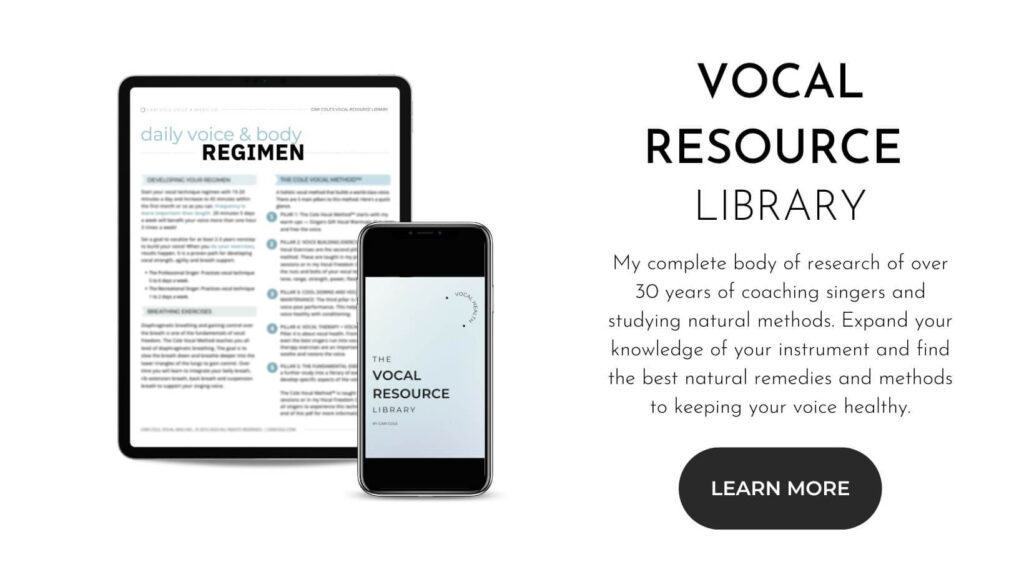
These techniques in this article are excerpts from my Vocal Resource Library where I have a section called “Mastering a Song”. This section breaks down how to master a song for performance. Here is an excerpt. For the full outline on Mastering a Song click here -> Vocal Resource Library.
3. Mastering a Song: Matrixing the Melody
The first step is to program the notes into your muscle memory. This is perhaps one of the most important steps when you are preparing a song for performance or the recording studio. We have put together a full outline of everything we use as professional singers.
I have a system I developed I call “Matrixing the Melody.” Think of it as a roadmap for your notes that programs the notes of your melody into your neuron muscle memory. This step programs the notes of your melody into your neuron muscle memory. Particularly useful for preparing material for a performance and the recording studio! Matrix* the melody by finding the corresponding notes on the keys of the piano. This anchors the intervals of your notes solidly. Continue this step until you are consistently hitting the “bulls-eye” of all the notes in your song.
To help hit those high notes and have more power and volume here’s a few more tips to try!
- For better high notes, try this: Think down for higher notes: Like an elevator
- For more power, try this -. To have more vocal power (and sing better high notes) — try this. Keep your chest up and your chin pointed slightly downward lengthening the back of your neck. When you keep your chest up and your chin level or pointed “slightly” down, you will have more power and control over your voice which will help you get more emotion and not choke over your high notes!
- For more volume, try opening your mouth more and imagine the sound filling your mouth and resonators. As singers we tend to push the air out which only puts the sound in our throats instead of our resonators. Try it and see if it works for you. For more information and a demonstration visit the video on my YouTube channel here.
4. Mastering a Song: Monologue the Lyrics
This is a powerful technique that gets pretty instant results and helps you connect more deeply to your material giving a more power-packed emotional performance. Often by the time you perform or record a song you have rehearsed it so many times that it can become a bit robotic. In order to keep it fresh, you can use the practice of monologuing the lyric (like an actor would) to reconnect with the emotion of the song. This immediately connects the singer with their feelings and instantly enhances the vocal performance. I used this technique for years in my performance classes. We would focus the camera on the facial expression of the singer while they spoke the lyric out loud like a monologue or reciting a poem. You can really tell if someone is connected or not. Then once the lyric recitation becomes emotional you can step into the song. The result in emotional delivery was night and day. It’s an incredible technique that gets significant results. Try it and see if it works for you!
5. Mastering a Song: Perfecting Your Phrasing (Matrix the Rhythm)
When you want more emotion or soul in your vocal performance, phrasing is your friend. The heart of the “soul” of the vocal line is in the rhythm of each phrase. Singers who “sit in the pocket” come across as more emotional and more soulful singers.
Many singers think of the vocal line as “melodic”, but the vocal line is also “rhythmic”. Leaning into the rhythm – emphasizing the downbeats, and sitting in the pocket as well as keeping a strong beat of the song in your body will help you connect to a more emotion-packed vocal performance. This is especially important in recording when the voice is under a microscope and every second of delivery is on the spot.
One amazing technique to instantly get more emotion is to put the emphasis on the words that occur on the downbeats of the song. This immediately brings more emotion and feeling into the performance. However, avoid emphasizing generic words like: “a”, “but”, “the”, “and” that will sound unnatural being emphasized. This technique instantly brings more emotion and expression to singer’s voices.
Try a few of these tips:
- Try putting the emphasis on the downbeats
- Take the emphasis off of the “and, but, the, a” insignificant words and put it on the more emotional words!
- Tap out the rhythm of your your vocal line to a “click” or metronome. Hit the notes with a pencil or clap it – try to be as accurate as you can, as a drummer would drum it. Feel the rhythm of your vocal line and how it sits into the beat or pocket of the song.
6. Marking
Marking is a technique for rehearsing in a light but with tone (not a breathy sound). It is a powerful technique that trains the voice to accurately execute the intervals of the melody line and find the center of pitch without strain. When you rehearse a song this way, you will perform with greater ease and better pitch. When you only rehearse at louder performance volume it programs the wrong movements into the voice’s muscle memory, developing bad form.
Check out my “Mastering a Song” article in my Vocal Resource Library for a step-by-step process to help you get the rhythm into your vocal performance.
Related
Share this post
Categories

Hi, I’m Cari Cole.
You’ve got talent, but you want to become great at it. You’re in the right place! My mission is to help you refine your unique artist vision to bring to the world.
INSTANT ACCESS

VOCAL HEALTH QUIZ
Assess your vocal health + heal your voice with my quick quiz + guide!

by Celebrity + Holistic Vocal Coach, Cari Cole

About Cari Cole
Cari Cole is the CEO / Founder of caricole.com and CCVM: Label Without Walls. She is a Holistic Vocal Coach, Artist Development Expert, A&R Director, and Songwriter based in New York City helping artists for the past 38 years. She is a mentor for Women in Music and The Association of Independent Music Publishers.
Her latest venture, CCVM a label services company, provides artists with a seamless path from creation to completion. After 30+ years of observing the overwhelm and challenges that artists face, Cari pulled together the best top creative professionals and designed a new approach to supporting our artists.
Disclaimer:
The information provided on Cari Cole's website is informational only and should not be used for diagnosing or treating a health problem or disease. Those seeking personal medical advice should consult with a licensed physician. Always seek the advice of your doctor or other qualified health provider regarding a medical condition. Never disregard professional medical advice or delay in seeking it because of something you have read on Cari Cole's website. If you think you may have a medical emergency, call 911 or go to the nearest emergency room immediately.