Individuals considered authentic are those who strive to align their actions with their core values and beliefs with the hope of discovering and acting in sync with their true selves. Being authentic involves the ability to be introspective and understand what motivates oneself. Authentic people won’t look to others as much for approval nor easily surrender to social pressures. They get their validation from their own internal and moral compass. They are usually independent thinkers who have developed their intuition and can rely upon their own judgment.
Authentic:
1: real or genuine: not copied or false
2: true to one’s own personality, spirit, or character
3: honest
Society and modern culture, in general, ask us to project an image of ourselves onto the world. Don’t show your “real self” it says. Add to that any trauma which leaves us not in touch with our natural instincts and we struggle to know our real selves. Anything that pressures us to be other than we are – peers, friend groups, parents, teachers, social media, the need for approval, to be liked, sabotages our authentic voice.
Add to that – the music business is mostly anything but authentic, how on earth do you be your authentic self in this industry?
However, the truth is that while the periphery of the business and one-hit wonders in it are pushing music that is up on the surface of life, that to really have staying power and win critical awards, comes from the artists that aren’t afraid to be themselves. Matter of fact, it’s their superpower.
A quick look and listen of these epic artists and you know they wear their heart on their sleeve for the whole world to see. Their success lies in their ability to know themselves and use their own lives as collateral for their work. It relies upon it.
- Adele
- Prince
- SZA
- Sam Smith
- etc.
We veer from our authentic voice when we are not in touch with our gut responses or are used to denying them.
If your life has been riddled with difficult people and circumstances, chances are you’ve had a harder time being authentic. Developing an authentic voice is one of the hardest but most important aspects in a fulfilling life as a writer, as a creative, and as a person.
Genuine people share a few key traits. They tend to take time to develop an opinion and speak their mind, respond to internal expectations rather than external ones, and forge a unique path to fulfill their passion and purpose. They aren’t threatened by failure and can admit their faults. They are often less judgmental of others and have strong self-esteem.
It takes courage to be authentic.
How does one become more authentic?
1. Get to know yourself.
Knowledge is power. Self-knowledge is destiny. Once you truly know yourself as a person, your art will dramatically improve. You have to know your own voice and who you are in order to make meaningful art. Whether you choose to operate as a persona or your real self, your real voice is always at the core.
2. Develop authenticity in your writing.
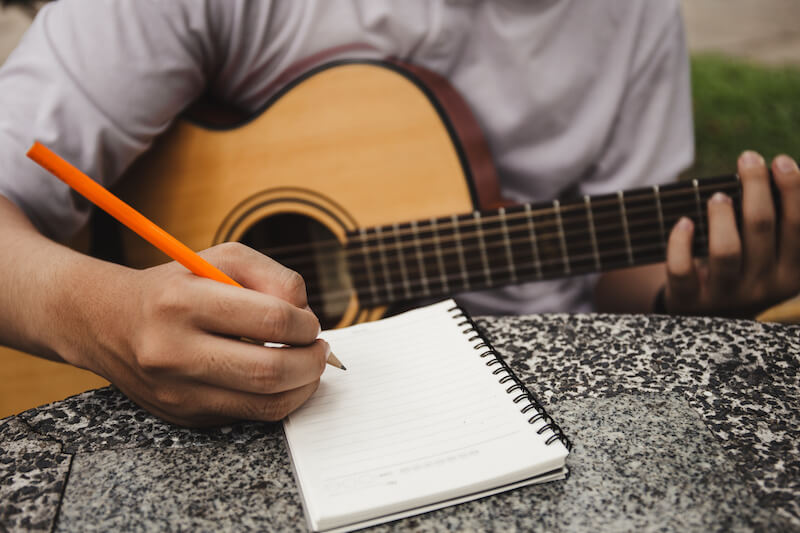
Developing an authentic voice in your writing is an ongoing process derived from getting to know yourself. Try writing from real-life experiences for an entire month as an experiment. Focus on writing things that are close to your heart. Want to learn how to write lyrics from your authentic voice?
Come join us for our next run of the Signature Songwriting Circle, starting October 18, 2022! We take a deep dive into you and walk you through our alchemical process to find and refine your artist vision to get YOU in your songs. Learn more here.
3. Examine your core values and beliefs.
Examining core values and the roots of current beliefs can help develop more authenticity. Observe yourself objectively.
- What are your core values? List them.
- What are your core beliefs? Make a list.
Examine belief systems that you developed in childhood or ingrained patterns that no may longer serve you. Make a list. What are your real beliefs? Pay attention to the ones underneath the surface beliefs. Frequently inventory your beliefs. And then choose to continue to believe them or do some work to expel outdated beliefs that no longer serve you.
4. Observe yourself more objectively.
Many philosophers through time talk about the power of developing objective view of oneself. Often referred to as becoming the “witness”. Pretend that you’re a fly on the wall witnessing yourself from outside of yourself in your day-to-day interactions. How are you interacting with others?
- What are the ways in which you interact with people?
- Are you defensive, offensive? Aloof or detached?
- Do you prefer to lead or to follow?
- What is your overriding motivation in your communication with others? To help, comfort or inspire others or more for yourself?
- Observe which actions and choices feel authentic and which do not.
- What did you notice that surprised you?
5. You are whole on your own.
Modern culture has taught us that we are not whole on our own. We need a relationship to make us whole. We need approval to complete us. It’s in our movies and books, it’s in our culture. But what if what really need is our own approval? What if we are whole on our own? You don’t have to agree completely, just consider what it feels like if that was true? Totally of changes things – right? Perhaps we can be connected to others without needing them to make us whole. Feeling more whole allows us to be more authentic to our own values and more in touch with our true selves. This is powerful for your art.
6. Practice being yourself.
Being authentic requires courage. Revealing your true self could garner disfavor from others, such as by expressing opposing political beliefs or sharing honest feedback with a loved one. It makes you vulnerable to rejection or betrayal. Especially when it comes to your music. But if you are not yourself, you might be missing something special or unique about you? Additionally, authenticity demands tremendous mental energy—the willingness to continually evaluate your values, your options, and your actions. But so worth it. Who said making great art was easy?
7. Becoming more genuine.
We are drawn to genuine people—rather than people who simply agree with whatever we say or do—because those who are true to themselves are also likely to be true and honest with us. Authenticity is also associated with many appealing traits, including confidence, strength, individuality, and emotional resilience. Make a list of artists who affect you like this. Examine their songs and their core subjects. How do they bring their authentic selves into their music?
Developing an authentic voice is paramount as an artist and writer. You can’t write about what you don’t know about, intimately (back to #1 above – it all starts with getting to know yourself). You also can’t write about what you don’t have a perspective on. I.e.: when something is too raw.
We have a process we use in our Signature Songwriting Circle that guides songwriters to their authentic voice and shows you how to write more authentically in a fun and easy way. There is a supportive community for you here, ready to guide you into the artist artist you dream of being. Ready to start the process? Click here to learn more.