

5 Tips to Keep Your Singing Voice Healthy Naturally

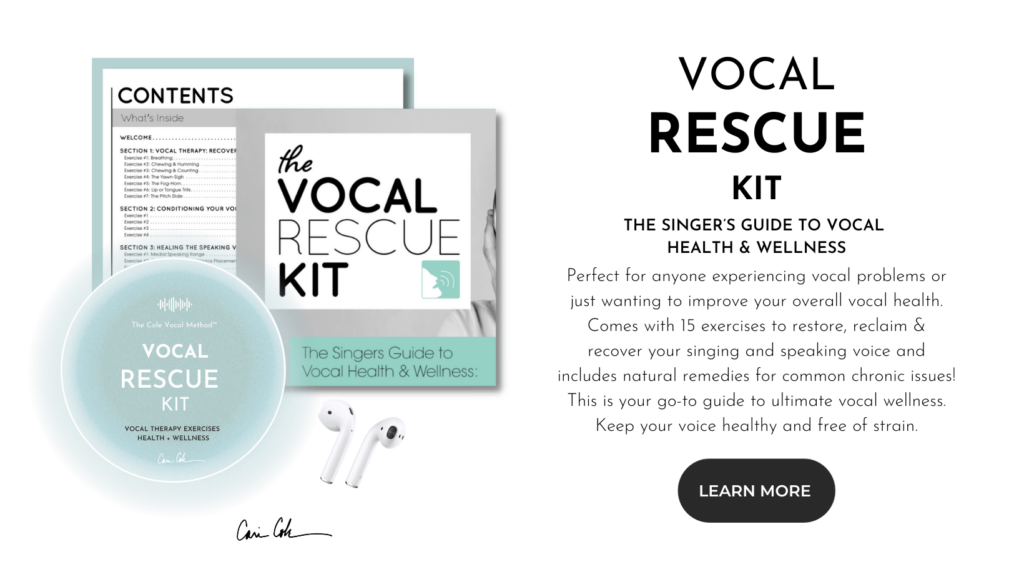
This post helps you get started, but that’s only the beginning. What would it feel like to sing your heart out with a transformed healthy voice performing to thousands of people by the end of the year? Come join the thousands of singers who have already transformed their voices with my Vocal Rescue Kit. Get your voice back on track in just 15-minutes a day with these revolutionary vocal therapy exercises and techniques for your singing and speaking voice–only found here! Click here to find out more.

From time to time, even the best singers run into vocal issues. The voice is a physical instrument inside the body and is affected by the environment and the wear and tear of performance and singing professionally.
Maybe you need to get your voice back post COVID, or or just improve overall vocal health issues with chronic hoarseness or losing your voice after a gig.
Sometimes it can be tricky to figure out exactly what you need to do to get back on track. Anytime it happened to me, I would immediately wonder if I would ever be able to sing again!
A huge part of my vocal technique is the elements of vocal health because singers need all the right tools + techniques to withstand the wear and tear of performing. Over the years I’ve helped countless singers restore their vocal health addressing a large number of vocal problems using my vocal therapy techniques and long list of natural remedies.
Learn about my vocal health system below to restore your vocal health, condition your voice post show and reduce inflammation. Keep your voice healthy on or off the road.
To improve vocal health there are a few things you can do to feel a difference.
1. Abstain from talking repeatedly over loud noise
Talking loudly over very loud noise or using your voice loudly like cheering at a concert puts unnecessary strain on the vocal folds, and can even damage the voice.
If you are out at a social event, you can excuse yourself early especially when you have to sing the next day-or just for better vocal health.
If you are at a concert you can cheer without making noise! In other words – look like you are cheering with joy but make no sound :). Singers need tools to save your voice at all costs. Find out more information here.
2. Eliminate glottaling
Glottals are a striking of the vocal cords that overtime will create swelling and inflammation that can cause more serious vocal problems. It happens mostly on words that begin with vowels like “ah” or “i” but can also happen on a vowel in the middle of a word like “st-ay”.
If your voice gets tired a lot you might be glottaling. The best way to find out is to record your voice and see if you hear a “hard” scratchy or striking sound on words that start with a vowel. Say “i” over and over again and see if you hear a loud striking sound.
If you have a tendency to use glottals, learn how to avoid them. In my Vocal Rescue Kit, I walk you through how to avoid glottals. Find out more information here.
When your voice feels tired, go on vocal rest. Well known by performing singers as the number one solution for an overused, hoarse voice, vocal rest is the first directive for persistent vocal issues from vocal doctors and coaches. Talking and singing on top of a hoarse voice can lead to more damage and an even longer recovery.
Vocal rest means no talking and no singing for a concentrated period of time. 2-3 days for a quick fix, 1-2 weeks for a more considerable fix, especially when symptoms are persistent. However, if symptoms persist, get a vocal scope with an ENT who specializes in singers’ voices to see if you have a nodule, cyst, hemorrhage or other vocal condition.
3. Eliminate strain by reducing tension in vocal muscles
Throat tension and vocal stress are common complaints. A lot of people suffer from the end-of-the-day vocal fatigue that comes from accumulated tension — from talking (on the phone) and/or using the voice incorrectly. Also keep in mind that most voice problems come from being dehydrated, a lack of sleep and overusing your speaking or singing voice without the correct placement or technique.
Your vocal cords lie within the “Adams Apple” in the front of your throat. When there is tension in this area there is a sensation of tightness, heaviness and even soreness in this area. When you speak or sing you’ll find that the “Adams Apple” usually moves upward and closes the throat. The result is a voice with a thin tight sound or an uncontrollably breathy sound, either lead to a sore throat and/or voice problems.
Tension is the enemy of good vocal production. Vocal problems are always accompanied by deep contractions in the muscle of and surrounding the voice, the right kind of vocal massage is extremely effective at reducing tension and restoring the voice. Massage is one of my secret weapons.Acupuncture is equally as effective.
Vocal Massage: I teach vocal massage methods in my vocal technique method because singers are always fighting off tension and inflammation and massage helps to relieve these issues.
Resources: You will find information about my vocal massage methods in my Vocal Resource Library and in my Singers Gift Vocal Warmups you will find my larynx pull-down massage exercise along with others.
4. Vocal placement for your singing and speaking voice
Get a good routine of vocal therapy exercises established following your vocal rest to help restore your voice. Doing vocal therapy for a concentrated period of time 1-3 months is recommended depending on your progress and needs.
Vocal therapy exercises: Vocal therapy exercises will help to restore your voice. I have created a set of vocal therapy exercises for singers to soothe and gently repair your voice. Use them whenever your voice needs some extra help or regularly to stay healthy. You can find them here: Vocal Rescue Kit.
Speaking exercises: The speaking voice can cause problems in the singing voice. Speaking from the throat or using glottals causing the cords to strike often, leads to hoarseness and vocal problems. I created a set of speaking exercises to help you get your speaking voice out of your throat and to stop rubbing the vocal cords. You’ll find them also inside the Vocal Rescue Kit here.
5. Use conditioning exercises post show to reduce inflammation at the vocal folds
Cooldown exercises are a series of conditioning exercises to reduce hoarseness, clear up excess mucous and help recover the health of the singing voice: The specific cooldown exercises in my Vocal Rescue Kit will take down inflammation in the vocal folds. They are used post-show or pre-show when the voice needs extra help.
Related
Share this post
Categories

Hi, I’m Cari Cole.
You’ve got talent, but you want to become great at it. You’re in the right place! My mission is to help you refine your unique artist vision to bring to the world.
INSTANT ACCESS


VOCAL HEALTH QUIZ
Assess your vocal health + heal your voice with my quick quiz + guide!

by Celebrity + Holistic Vocal Coach, Cari Cole

About Cari Cole
Cari Cole is the CEO / Founder of caricole.com and CCVM: Label Without Walls. She is a Holistic Vocal Coach, Artist Development Expert, A&R Director, and Songwriter based in New York City helping artists for the past 38 years. She is a mentor for Women in Music and The Association of Independent Music Publishers.
Her latest venture, CCVM a label services company, provides artists with a seamless path from creation to completion. After 30+ years of observing the overwhelm and challenges that artists face, Cari pulled together the best top creative professionals and designed a new approach to supporting our artists.
Disclaimer:
The information provided on Cari Cole's website is informational only and should not be used for diagnosing or treating a health problem or disease. Those seeking personal medical advice should consult with a licensed physician. Always seek the advice of your doctor or other qualified health provider regarding a medical condition. Never disregard professional medical advice or delay in seeking it because of something you have read on Cari Cole's website. If you think you may have a medical emergency, call 911 or go to the nearest emergency room immediately.